 Tim CookApple · CEO
“At Apple, we believe privacy is a fundamental human right, and we will keep working to support the strongest privacy bill possible.”
Federal privacy legislation · 3 June 2022


Human first.
Identity when needed.
A post. A payment approval. An agreement. ZOREAL Mark proves there’s a verified human behind the content and decisions they sign. Approve it on your phone, keep your name private or share it when needed, and let anyone check the proof.
Tim CookApple · CEO“At Apple, we believe privacy is a fundamental human right, and we will keep working to support the strongest privacy bill possible.”
Federal privacy legislation · 3 June 2022

A verified human. Their name stays private.
Real public quotes. Illustrative Marks and signer.
These examples do not imply the speakers use or endorse ZOREAL.
Portraits are cropped to fit the avatars. Quotations are excerpts from public posts and recorded statements, representing different viewpoints. Follow the sources for their full context. The views are the speakers’ own.
A post on X. A Reddit comment. An Instagram Reel, a TikTok or a YouTube video. AI-generated content, automated replies and synthetic media leave an important question unanswered, even behind a convincing account or a familiar face.
The same question matters when a payment request arrives, an agreement is accepted or a stranger starts a conversation. Before you act, you need more than a convincing message.
Is there a real person willing to stand behind this? Mark gives that person a way to say yes, with proof that travels with what they share.
“Every trust signal we have was built for a world where faking a human was expensive, and that world is gone.”
Y Combinator’s brief calls for verified humans on the other end of calls, messages and transactions—and real people behind replies, dating profiles and reviews, while protecting privacy.
What matters is the evidence behind the badge. A Mark connects the person, the content and the context of a signed statement.
Proof of human, verified by ZOREAL. Every personal Mark connects this content to a verified person. Their name is shared only when they choose.
A check of the signed content. Change the words, and they no longer match the original Mark.
The bound page or context. Move the content, and the result tells the reader where it was signed for.
A timestamp and the stated presence grade, so the evidence has a moment as well as a person.
Every personal Mark starts with you. Review this content, approve this signature, then share it where the conversation is already happening.
Write your post or comment. The extension prepares the content and page context, then shows a QR code to open the signing request on your phone.
Check the words, the context and how you’ll be identified. Complete a liveness check when required, then unlock with your biometric to approve this specific Mark.
Paste your content with its Mark. Readers can check it without a ZOREAL account. Your followers and the platform don’t have to sign up first.
Approve every personal Mark. A recent liveness check can cover a 15-minute window; biometric approval is still required for each signature. There’s no blanket approval for a batch of future personal posts.
ZOREAL IDA post, an agreement, a payment approval, a review. Mark the content you stand behind in the tools you already use. Bring proof of human to X, Reddit, Instagram, TikTok, YouTube and the decisions that happen beyond the feed.
Your platform doesn’t have to adopt Mark first. Publish your Mark in a supported text field, message, caption or comment; no signing integration is required.
Text and formatting limits still apply. A Mark needs its markers to remain intact.
Add a Mark to a comment or an article on your own site. The signed page address travels with the evidence, so readers can check its context.
A matching page address is part of the check.
See how checking a Mark fits into the places you already use. Two walkthroughs are on the way, from the content in your feed to the evidence behind it.
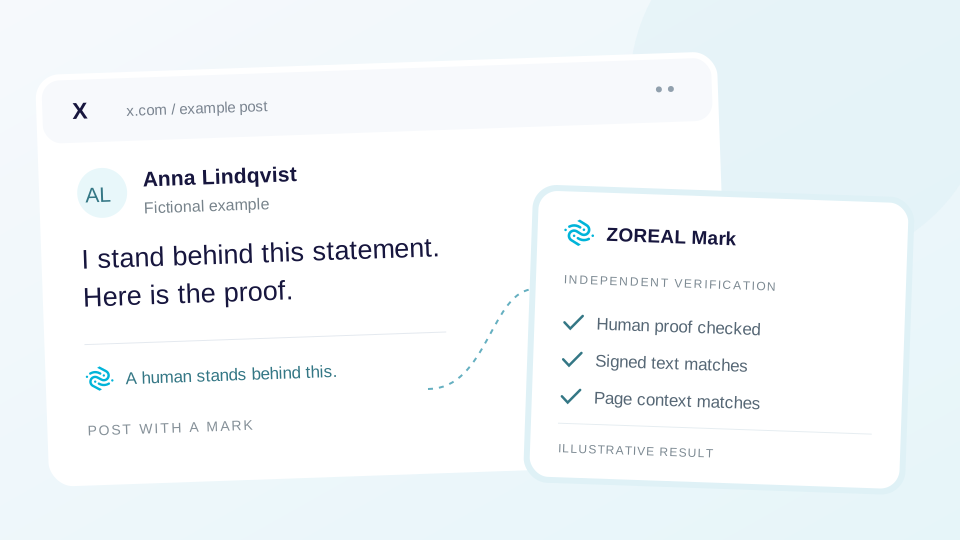 Walkthrough preview
Browse X, find a Mark and check the person, the signed text and the page it belongs to, using your own ZOREAL extension.
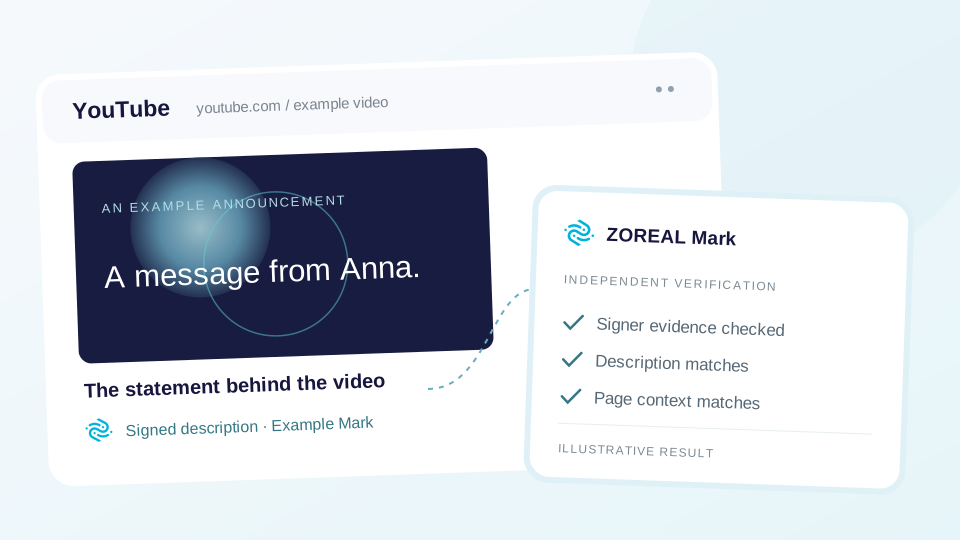 Walkthrough preview
Find a Mark in a video’s description or comment, then inspect who stands behind that statement and exactly what the signature covers.
Illustrative posters for upcoming recordings. The YouTube walkthrough will check a signed description or comment; it won’t authenticate the video’s footage or audio.
A website can draw a convincing badge. Use your own ZOREAL browser extension or, in the planned mobile experience, the Mark app to check the signed evidence behind it.
The reader’s tool checks the signature, the content and its context. It does not take the website’s word for it. You don’t need a ZOREAL account to verify a Mark.
See what verification checks“This is the statement
I stand behind.”
Your verification toolIllustrative extension panelCheck the evidence with a tool you control.
Illustrative results. This demo does not perform verification.
Sometimes you need to know a person is there. Sometimes you need to know who. Choose the question that fits the moment.
A site persona stays consistent on that site. Other sites receive different personas, so your public name does not have to follow every post.
Choose a legal-name Mark when being identified matters. The badge shows your name, without your email or contact details. Your name becomes part of the public signed record.
The public certificate can disclose more than the badge, including document metadata. Review the disclosure before signing. A public name remains public; planned withdrawal adds a status, not erasure.
For a public official making a statement, a CEO sharing an announcement or a creator speaking to their audience, a name can be only part of the story.
We’re planning application-based validation that can add a verified title, position or account association to a named Mark. Readers will be able to see which claims were checked.
An ordinary identity Mark does not establish a role or ownership of a social account. Extended validation is a separate, planned review.
Start where you already share. Our direction is simple: tools for the person posting and the person checking, with no platform partnership required.
Prepare a Mark from a text field, approve it on your phone, then paste it with your post or comment. Check the Marks you encounter with your own browser tool.
A dedicated place to create and check Marks on your phone. The vision includes pointing your camera at content or listening to a clip to find the signed evidence behind it.
Websites can add verification to their own experience. Integration is optional: a reader’s trusted tool can check the evidence independently of the page.
We’re working toward signatures embedded in audio and video, so a future Mark app can help people find and verify who stands behind a clip. Today’s specified file verification checks exact bytes; platform re-encoding can break that match.
Explore what’s built and what’s nextMark’s planned social features make the relationship clear: a person, a shared statement, an agent or an organization.
Unlimited signing. Unlimited verification.
The person sharing and the person checking both belong here.
What gets signed. What a verifier checks. What a Mark does and doesn’t prove.
What it means. What it shares.
What stays in the record.
ZOREAL combines liveness and biometric checks with hardware-bound signing keys, PKI certificates and signed presence evidence. Together, they connect a real person to the content they approve. Choose a site persona to keep your name private, or sign with your verified name.
Posts, comments, messages and the decisions you share: payment instructions, transaction confirmations, agreements, approvals, permissions, reviews and personal introductions. A Mark binds human proof to the content you sign. Files, audio and video use content-specific checks, with embedded media signatures on the roadmap.
Yes. Get the ZOREAL ID app and the ZOREAL Mark browser extension, then use your phone to approve your posts and comments. Signing and verification are free and unlimited.
No. A person can vouch for content they wrote, content they helped prepare, or AI-assisted content. A Mark connects a verified human to the content they stand behind. It does not establish authorship or prove that a statement is true.
No. The default is a site persona: a pseudonymous identity that stays consistent within that site. Different sites receive different personas. You can choose to sign under your legal name instead; that name becomes part of a public record and remains public after withdrawal.
No signing integration is required. The extension prepares a Mark as text to paste into a post or comment. The platform must preserve the markers and allow enough text; a platform can remove them. Readers can use their own verification tool. The Chrome extension and verifier are available now. The Safari extension is planned.
Changing the signed content causes the content check to fail. If the content matches but appears on a different page, the result says “Verified for another page” and shows the original address. A Mark created without a page address is labeled “Verified, not bound to a page”.
The personal signing flow can use recent presence evidence within its allowed window. Each personal Mark still requires biometric approval on the holder’s phone. The record states the actual presence grade, such as recent. Delegated Marks use the agent’s own key and identify the agent and its human authorization; they do not claim fresh human approval of each post.
Withdrawal is planned. It will add a signed, dated status so readers can see that you no longer stand behind a Mark. It will not delete the original signature or remove a legal name published with it.
Making and verifying Marks is free and unlimited on every plan. There is no Mark quota. Organization verification is separate from making an organization Mark.
It starts with one person and one thing worth standing behind.
Your post. Your choice. Your Mark.
We use cookies to keep you signed in and to remember your settings. Privacy policy